
The Need for Pattern Recognition in the Information Age
A crucial skill like no other

Hey guys! Sorry, it’s been a while. Along with being caught up in uni and life, I’ve been taking a step back to see how I can take this project to new heights and how I can provide value.
Most of my pieces have been connecting to the declining problem of deep critical thinking, and I’ve been gathering insight into how much this means to you, and also to get know you better.
Which is why I’ve created a short survey to help understand your challenges. I would appreciate it if you could fill it out before or after reading/listening.
Click here to fill out.
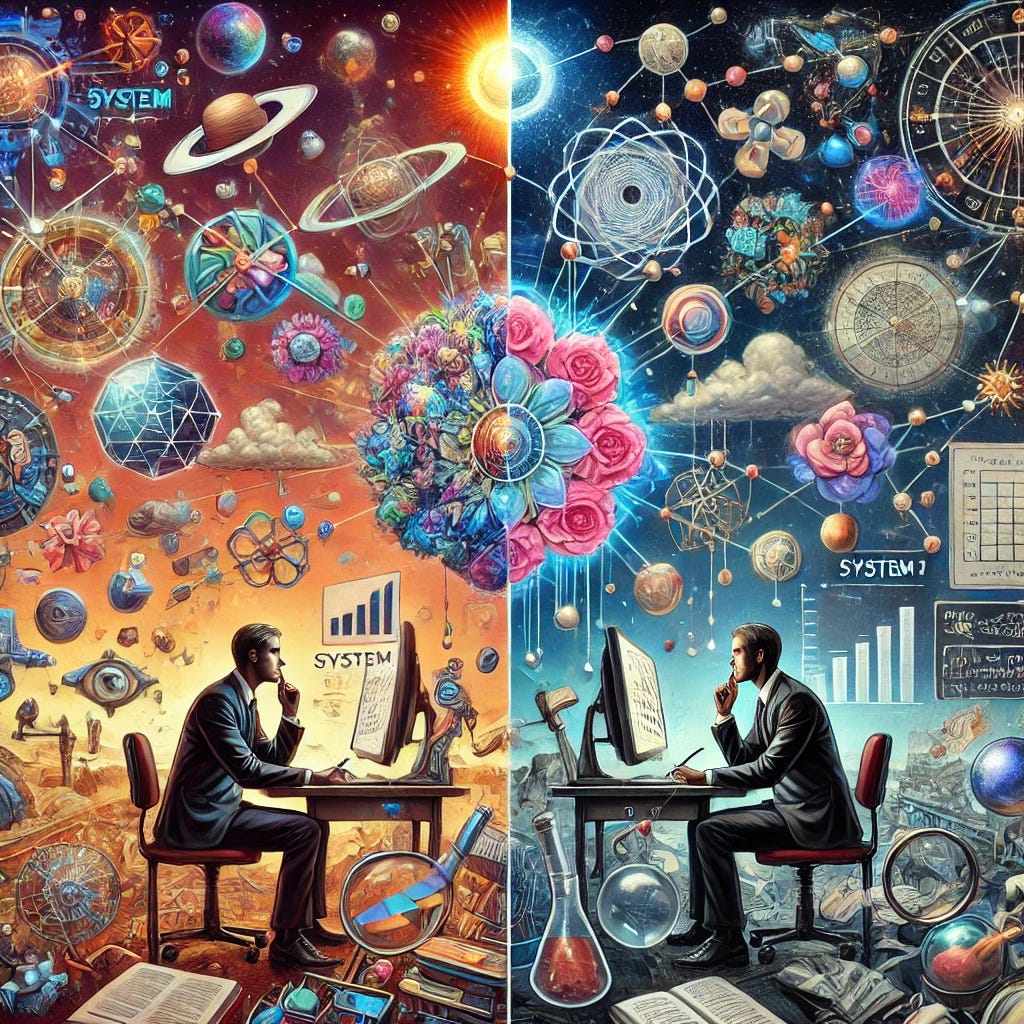
Information.
We have cracked the code for accessibility by leveraging compactness - information stored on websites, condensed into apps, and concentrated onto a small smartphone in our pockets.
The world’s wonders and secrets are available on demand. But here’s a question:
Where do you get your information from?
Is it from your regular mainstream news site, books, Substack essays, or a social media site?
I want to draw attention to one particular site:
TikTok.
The revolutionary video platform of bite-sized snippets of various genres, becoming the home for Gen Z. Ranging from entertainment to education…
To the news.
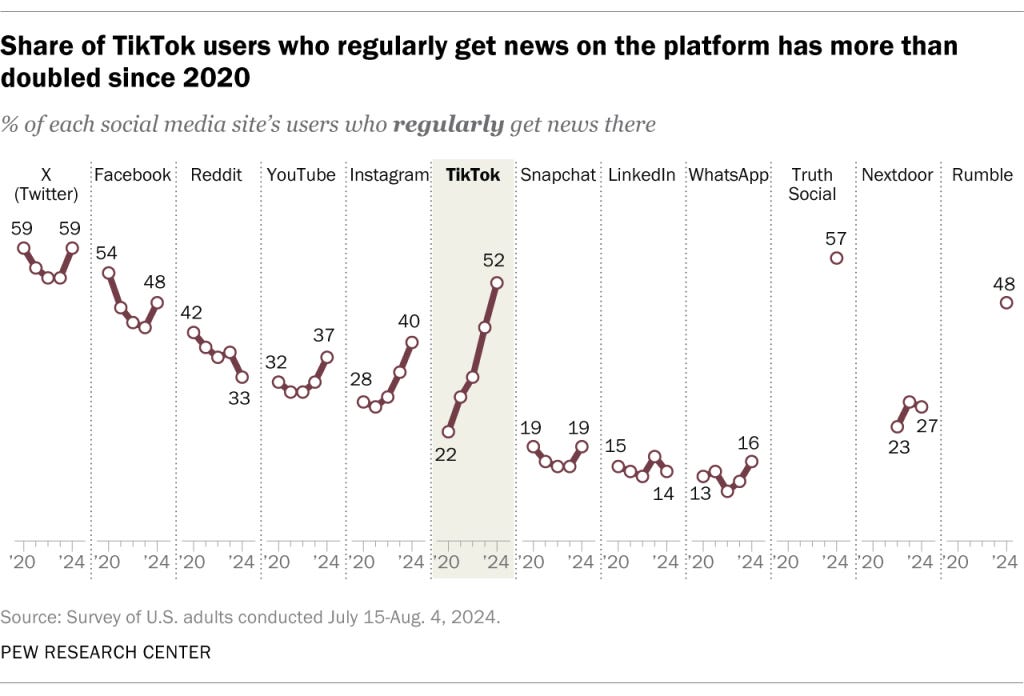
A 2024 Pew Research survey unveiled that many social media users get their news from TikTok.
What can you expect from a platform like TikTok to deliver the current state of worldly affairs?
60-second clips.
Good use of storytelling devices.
Annoying use of AI voiceover.
Turning complex concepts into easily explainable extracts.
Another example of leveraging compactness.
The human brain is certainly no stranger to leveraging compactness, which is the ultimate mechanism for making sense of the world with the information it has gathered.
And there is one process that does exactly that:
One which finds recurring sequences.
One which finds groups.
And one which isn’t well known.
Pattern Recognition.
And it is more important for this age of information than you think.
The TikTok Problem
Before diving into this mysterious superpower, we have to go further into what is enticing about the TikTok reels and how this platform, as a choice of consumption, represents us, human-thinking machines.
Now I’m not on TikTok, though if my business becomes a success and moves towards video, I may consider dabbling with it to reach the younger audience it houses.
But there is one trend on TikTok (and Instagram, too) that has stood the test of time and is fitting to our discussion here…
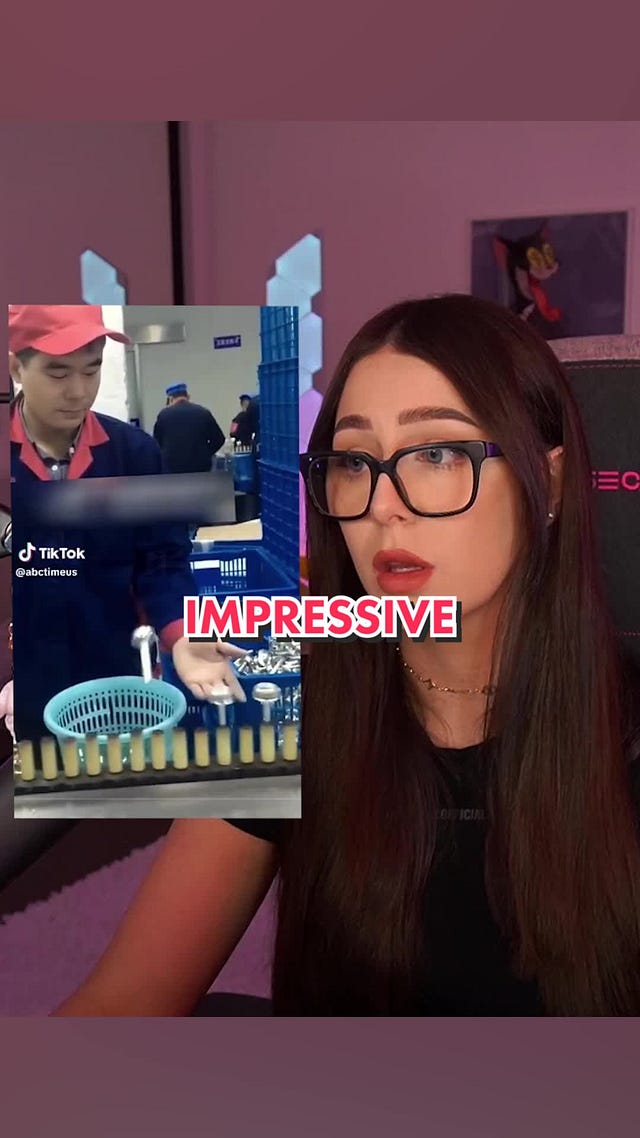
Reaction Videos

 Tiktok failed to load.
Enable 3rd party cookies or use another browser
 Tiktok failed to load.
Enable 3rd party cookies or use another browser
This format involves the creator or any person watching another video and then giving their authentic perspective to the audience.
Reactions to TV shows, sports games, memes, other TikToks, and, not surprisingly, political and social issues.
Emotions are expressed - subtle head-shaking, exaggerated gasps, referring back to the camera, and many others.
The reaction format is rampant…
But it is safe to say that, given what we talked about before, it paints a reflection on how we process information from a TikTok reel and express it.
This has become a significant revolution in where and how we process our information since the eras of the printing press and photography. And if we are watching reactionary content on serious social issues, then we are certainly talking about a revolution in how not just information-processing but also problem-solving.
Because of their short shelf life and intermittent rewards, there is no doubt that TikTok is addictive.
Fortunately, many creators are spreading awareness of the platform and its societal impact on human thinking.
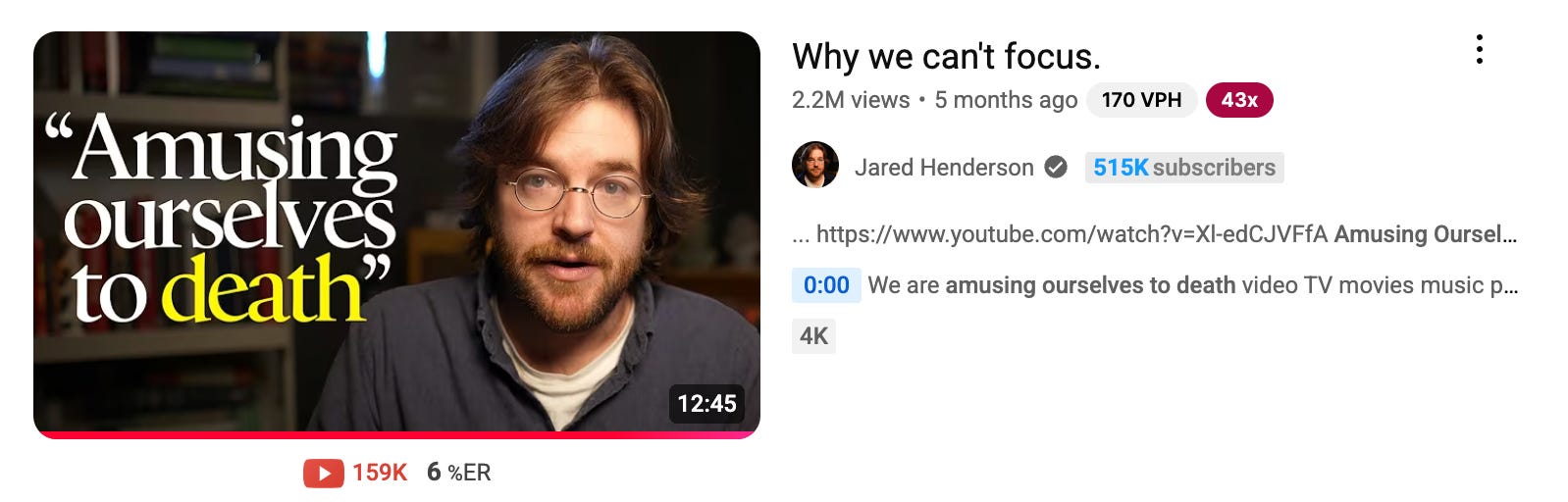
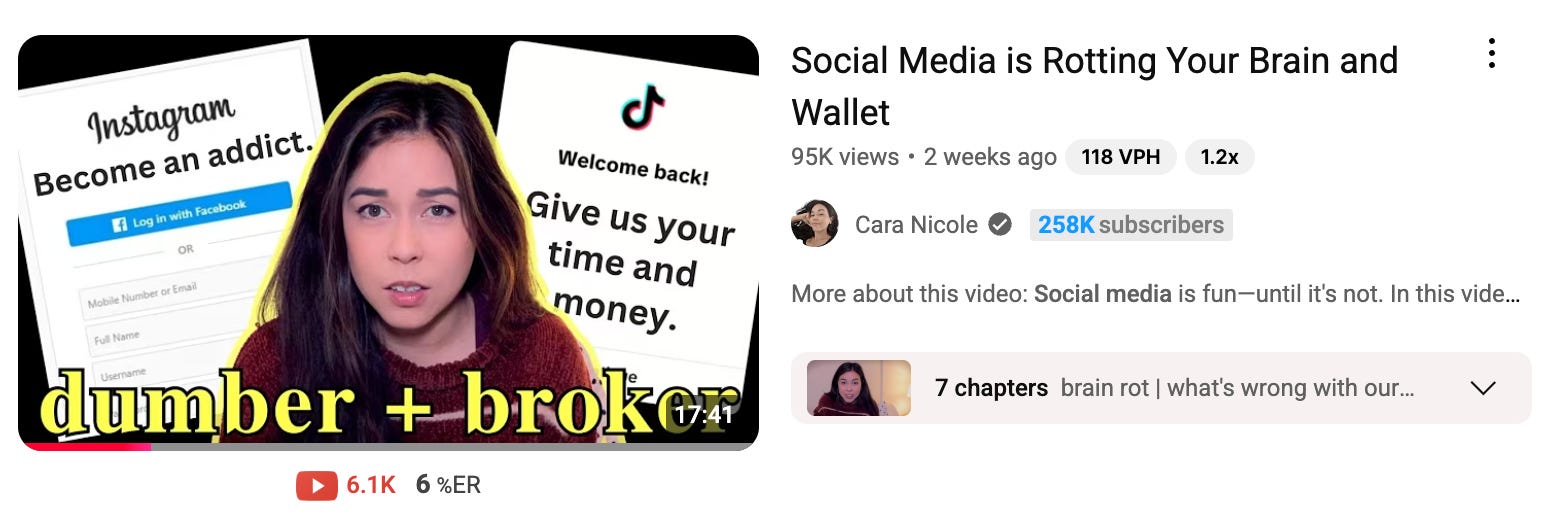
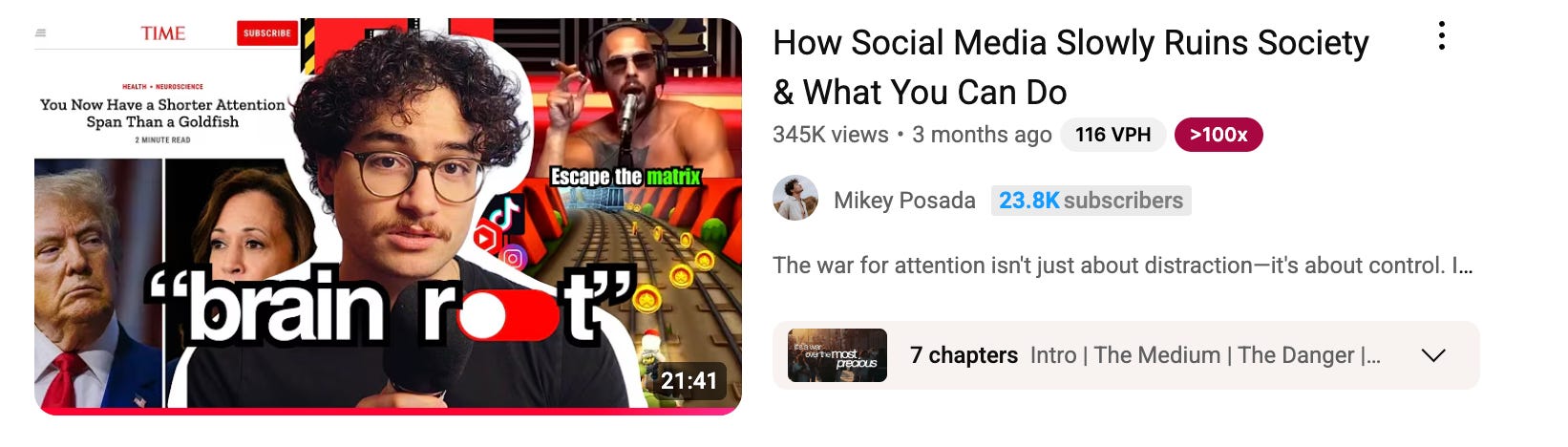
They share a reference to a book called Amusing Ourselves to Death, which describes the compromise of human thinking caused by the advent of visual media replacing print.
The TikTok reels show where we currently are:
An overreliance on surface-level understanding.
How does pattern recognition come in?
Here’s the truth:
We are on a constant search for patterns.
It is our evolutionary brain food. It forms the basis of predictions and narratives of reality.
Over centuries of evolution, humans’ pattern recognition skills determined natural selection. Hunters skilled at spotting prey and predator and telling poisonous plants from healthy ones offered them a better chance of survival than those blind to the patterns. It enabled the survivors to pass on those pattern-friendly genes to future generations.
Neil deGrasse Tyson
So when we consume content, like a TikTok reel, we observe an unseen event; unheard sentences and new perspectives. But here’s the trick:
The brain connects this new information with existing information retained.
The cognitive aspects of pattern recognition are complex because it is an umbrella term for elements such as memory, attention, and, in this case, perception. Hence, multiple areas are involved, including the prefrontal cortex, hippocampus, and neocortex, and this is something I’m currently [researching](articles).
However, there is a simpler way to explain this, courtesy of the late Daniel Kahneman and his book Thinking, Fast and Slow. In this bestseller, he introduces two methods of thinking referred to as System 1 and System 2.
System 1 describes the rapid-fire and intuitive decision-making, whereas System 2 describes the slower and concentrated thinking.
System 1 is more prone to cognitive biases because of these on-the-ball decisions, but System 2 can polish System 1 to act better.
As a result of this automated decision-making, Daniel associated System 1 with pattern recognition.
He references certain cognitive biases that System 1 thinking uses to recognise a connection, one of which is called familiarity bias. As the name suggests, there is a tendency to favour knowledge and beliefs that we already know as opposed to those unfamiliar to the person.
This mechanism can explain the mystery of our TikTok problem:
When we react to a video and find patterns to make sense of the information, we connect what we observe to our prior experiences, from the superficial, like reading an article and catching other related articles from our feeds, to the deep, like having conversations with people and specialised work. But sometimes, and this may sound a bit harsh, these experiences can be relied on too much, and may prevent a curious, open mind.
This is because System 1 thinking is much, much more energy-efficient than System 2, as the biased heuristics take very little effort to reach a closing narrative. It’s as if we are trying to make our prior experiences worthwhile and powerful enough to support your conclusions.
But how does pattern recognition become a superpower?
As much as I respect Daniel Kahneman for his legacy, I disagree with associating pattern recognition with System 1 only. System 2 can also harness this cognition, but just a lot slower…
And deeper.
This is a more deliberate and demanding process to recognise patterns or formally where the brain “perceives several items of information as a single [group],” even as less obvious groups. This is known as chunking.
Finding these groups is challenging and takes a significant amount of cognitive resources to get to the bottom of hidden secrets that need to be brought to light.
That is why it is important to schedule blocks for deep, focused thinking, especially if you come across issues that you care about and are becoming trends. When to share your view is up to you:
Do you need to respond immediately to keep the conversation going?
Or
Do you want to spend more time thinking about what has been said from different perspectives to achieve a clearer picture before responding?
There’s no right or wrong way.
There is nothing wrong with System 1 - it keeps us alive amid danger.
There is nothing wrong with System 2 - it keeps us from errors and knowledge gaps.
It all depends on the complexity of the issue.
But we shouldn’t compromise one system in favour of the other. We can harness both even in our deep thinking hours.
Here is a suggested tactic:
Use System 1 to grasp a broad overview and capture any rapid patterns you recognise, to prime you for deep pattern recognition or chunking.
Using your primed patterns, collate any resources (books, research papers, etc) and use System 2 to find invisible groups and relationships. This will correct your System 1 and change your perspective from what you thought before.
The take-home message from this piece is that our pattern-seeking capability is the ultimate weapon for these challenging times of information deluge, and helps calm our desperation to make sense of reality.
The question is:
Are you aware that you are using this ability now?
Pattern recognition in the midst of a huge, overwhelming, destructive force is the way out of the maelstrom. The huge vortices of energy created by our media present us with similar possibilities of evasion or consequences of destruction. By studying the patterns of the effects of this huge vortex of energy in which we are involved, it may be possible to program a strategy of evasion and survival.
Marshall McLuhan
This was super insightful! Thanks Mark!
Social media triggers three groups of cognitive biases .
1. Too much information.
2. Not enough meaning.
3. Need to act fast.
Then couple that with algowhoring and you've got triggers all over the place that hijack your brain.