
An interdisciplinary take on the Tylenol-Autism Debate
From an aspiring polymath with a pharmacist background

DISCLAIMER: This piece is not intended to be political in any sense or provide medical advice for how to take Tylenol (paracetamol/acetoaminophen) during pregnancy, despite having a pharmacist background. If you have any questions relating to taking any medication during pregnancy, please do not hesitate to speak to a pharmacist or doctor.
I don’t like to rant.
I don’t intend to in this piece.
You may not agree with me, but I personally don’t think it is wise to produce a reactive response to an issue that is inherently complex in nature. Certainly when it comes to this one that has emerged in the past week…
Not taking Tylenol during pregnancy as it leads to autism.
“Don’t. Take. Tylenol,” said President Trump, with Robert F. Kennedy (RFK) Jr standing behind him, still-faced with invisible support.
This referenced a “rigorous” literature review showing supportive evidence of most studies finding a link between Tylenol and autism during pregnancy.
After the speech, the debate incited.
A debate regarding a cheap everyday painkiller used during pregnancy.
For those of you who are new or reading my content, I’ve been a pharmacist for almost 5 years and a lifelong curious and fallible learner trying to understand the world. But I’m also very passionate about how we think in this age of evergrowing complexity and how a polymathic mindset can be a significant way forward - using our human curiosity to explore complex issues from multiple perspectives. On my social media feeds, many pharmacist and non-pharmacist friends responded instantly to the commotion from President Trump’s piece with reposts of stories and reassuring government confirmation of Tylenol being safe and possessing no teratogenic effects.
I’m going to be honest and say I 100% agree that Tylenol is completely safe and it should be continuously monitored.
However, the problem with this debate is not just signs of objective medical misinformation encountered. But rather a deeper, unexplored issue with how we approach it.
And to explore this issue, let’s actually use human curiosity to decipher the angles involved. This is going to have a lot of detail, exploring how each angle paints the big picture of the issue, so this may get a bit too complicated but I believe for the benefit of ourselves we should be viewing complex issues in this fashion.
The Techno-Sociological, Political, and Cognitive Perspectives
The age we live in is a technologically enhanced version of society, how we behave, and importantly how social media plays a role. Content creators are capitalising this age, learning how to craft titles, thumbnails, and hooks to grab attention and “expect” engagement. Social media algorithms are cleverly designed to catalyse this goal and prioritise controversial and inflammatory content.
With these features in place, it has captured the attention of many individuals and commentators for discourse, hence why I combined both sociological and political perspectives due to this overlap. Unfortunately this discourse is projecting towards an unhealthy direction for society as a whole.
Commentators have been reacting by looking at other people’s reactions, particularly from those in the opposite end of the political spectrum and even doctors. These reactions have consisted of short-form:

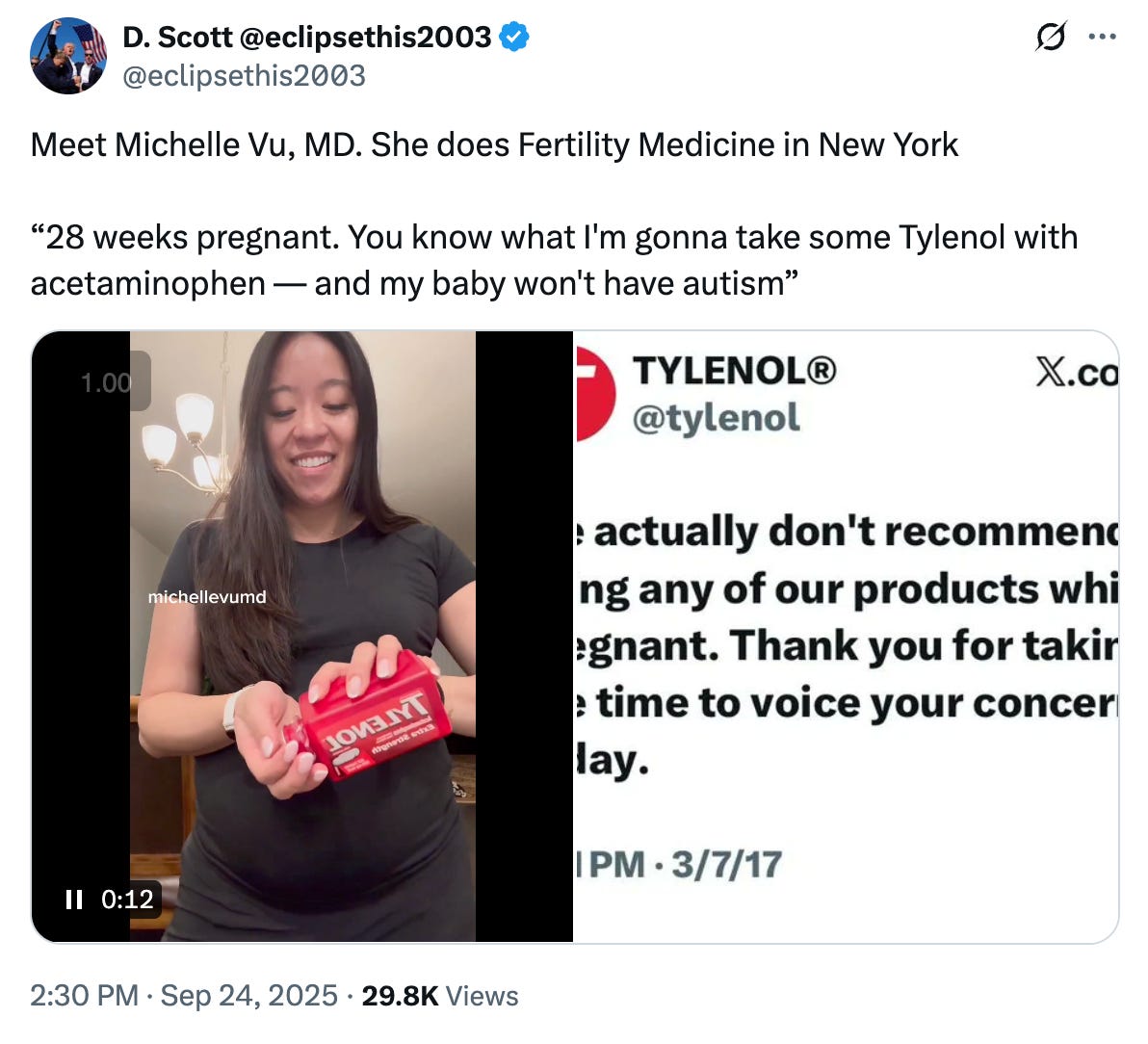
And of long-form:

If you’ve been following along, I’ve been referencing Marshall McLuhan, the Canadian media theorist, and the book Amusing Ourselves to Death by Neil Postman, which was inspired by McLuhan’s cultural concept of:
The Medium is the Message
In issues like these, it is worth explaining briefly why this is relevant. Any medium will have a different portrayal of the message due to the amount of context and critical thought invested. The evolution and cognitive convenience of modern media like pictures and video have changed the way we thought about issues compared to the original literal society.
Let’s start with the two short-form content - a Facebook Post and a Tweet:
It surrounds a fertility doctor who takes Tylenol whilst being visibly pregnant, joining the trend of TikTok mums expressing their blatant disagreement with President Trump’s and RFK Jr’s announcement with style. The two posts start with, “This is Michelle” or “Meet Michelle”, adding her known credibility, quoting her words during the stunt, and one ending with an ironic question. The tweet leaves a screenshot of a historical 2017 tweet from Tylenol not recommending use of the products during pregnancy, as if it were a response to a query. The responses to each post were those of direct anger or satire of these people and what their associates do, for example, how liberals take their medication, showing a photo-shopped individual with an open mouth and Tylenol tablets pouring down, as well as their links in the abortion debate. I think that’s enough observation.
As for long-form content like the YouTube video, it is expectedly more detailed. In fact the video above which is from a conservative commentator named Isabel Brown, discussed the study referenced, clips from the President’s speech, highlights her own research of Tylenol’s previous statements and linking to the present situation. This isn’t exhaustive, but it shows more room for nuance and disclaimers, which are very good signs.
But in case of most political commentary, most of this involved reacting to the TikTok videos which we just discussed as well as associates, making it a fantastic source of long-form entertainment!
Look at the word “associates.”
The human brain is a pattern recognition machine. It is a cognitive ability that it cannot help but execute and express. Through multiple exposures and experiences, the brain connects and compiles them to form a hypothesis of the situation at hand. So in the case of reading a short-form content piece about this trend of “TikTok mums”, comments are formed based on prior experiences of what the consumer saw:
Exaggerated behaviours linking to those in the liberal movement.
Pregnancy linking to the abortion debate.
Doctors who had a history of public views that were criticised.
As you can probably tell, the creators and the comments seem to originate from those in the conservative movement. Another pattern recognised.
Connections are formed, hypotheses are expressed.
Pattern recognition is a survival mechanism dating back to our ancestors, we cannot make sense of information without it. But there is a problem.
Most of this pattern recognition is unconscious and bias-prone, which is a result of fast unconscious thinking to form these connections. This is known as System 1 thinking, popularised by the late Daniel Kahneman in his book, Thinking, Fast and Slow. It is a cognitive shortcut using very minimal energy to process the observations.
Again this is a survival mechanism; we cannot live without it.
But the techno-societal transition towards visual media stimulating as many senses as possible and the extreme abundance of short-form content poses an affective response with very little time to deeply process every piece of relevant information to make sense of the issue properly. All these factors are understandable since we are only human, but the social media algorithms are falsely encoding human values, and users overperceive moral outrage felt by individuals.
But in my opinion, the abundance of favourable short-form content and reactive political long-form commentary exploiting our System 1 pattern recognition has created a false representation of a specific group being criticised. The comments and reactions create an unhealthy generalisation of how a group behaves and being applied to literally all members, regardless on which side you agree with:
The right is accused of being narrow-minded.
The left is accused of being emotional.
This is why we need to encourage depth and nuance, and acknowledgement of complexity and resorting to healthier content like research articles, books, podcasts, even YouTube videos and Substack newsletters.
The Statistical Perspective
Okay, that was an incredibly detailed view on how social media and politics are involved, and any more detail would probably turn this essay into politically motivated direction, which I certainly don’t want to do!
Let’s move on to a more pragmatic angle, because after all this situation was based around academic research.
Alongside the President and RFK Jr, the FDA commissioner, Dr Marty Makary, gave his speech referencing the following study:
“4 weeks ago a Mount Sinai Harvard study reviewed all existing literature. and found the overwhelming body of evidence points to an association. Sure, you’ll be able to find. a study to the contrary. That’s how science works. but to quote, the dean of the Harvard School of Public Health, there is a causal relationship between prenatal acetaminophen use and neurodevelopmental disorders. of ADHD and autism spectrum disorder….”
This study was the aforementioned literature review co-conducted by Dr Andrea Baccarelli, the Publich Health Dean of Harvard, who met with RFK Jr and National Institutes of Health Director Jay Bhattacharya for discussion.
But there was no public statement of Dr Baccarelli stating a definitive causal relationship; he only mentions “evidence of an association between exposure to acetaminophen during pregnancy and increased incidence of neurodevelopmental disorders in children…”
In scientific research, the concept of correlation and causality is one of the most fundamental distinctions, but the majority of research point towards the correlation direction because of rigorous methodology involved. So from this, we can pose substantial criticism to the US Government’s statement on causality over correlation, leading to the President saying, “don’t take it.”
But the nuance doesn’t stop there. If statements are being put out, why not look at the literature review itself?
I’m going to use the tool Anara to read the research paper and synthesise the relevant findings. They have an AI chat feature allowing to find a plausible response to each prompt highlighting from which section it is referring to. They’re not sponsoring this newsletter, but if you click on this referral link, you can get a nice discount on your first purchase and I get a nice kickback from this. So if you’re a budding researcher who has no time to read a lot of research papers, Anara is a fantastic resource.
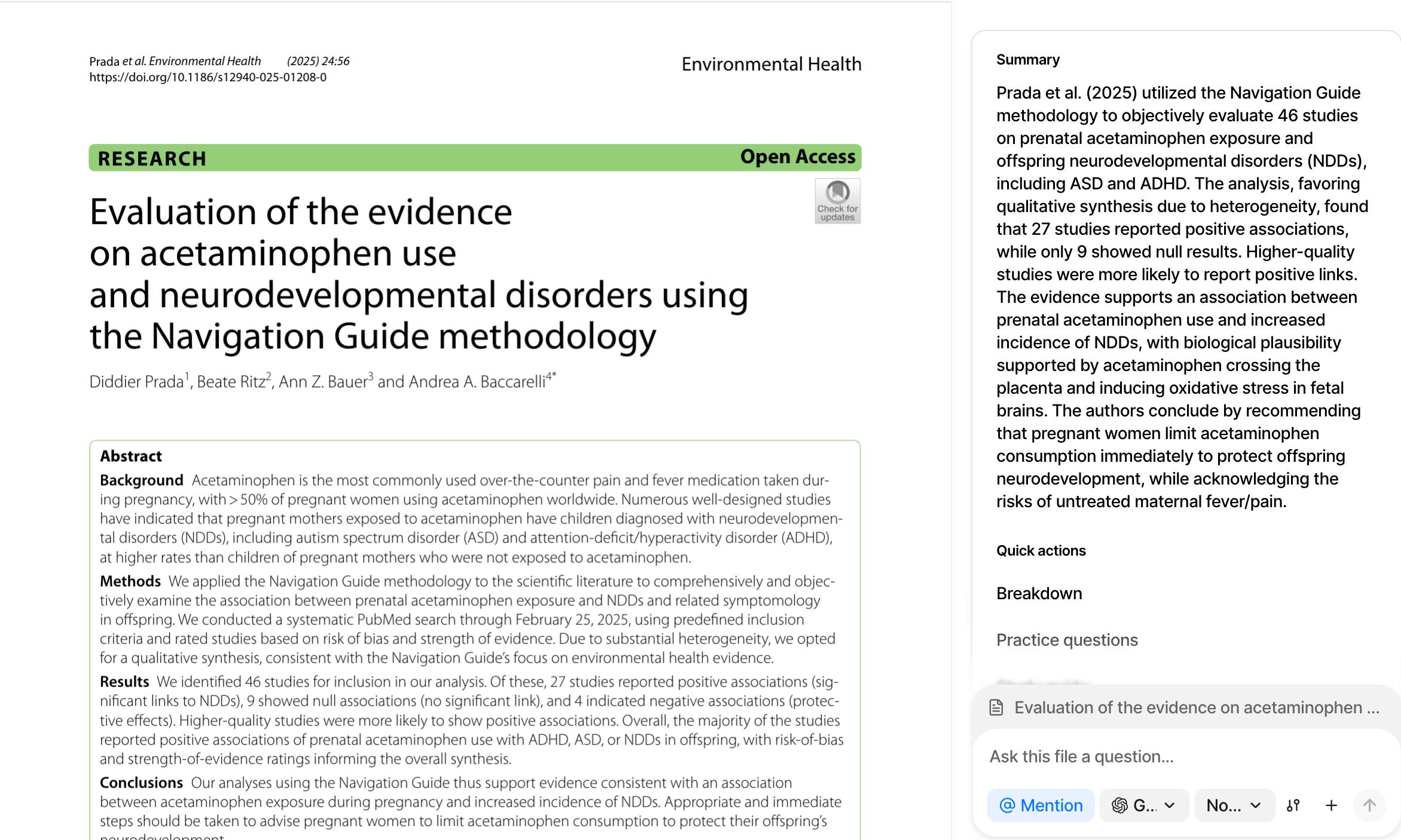
When you are reading scientific research like this, there are a number of important points to consider:
Funding of research
Potential associations of the authors
Statistical methods and confounding variables
This sees how they have influenced the results and whether there are true associations or if the US Government sees a true causations.
We identified 46 studies for inclusion in our analysis. Of these, 27 studies reported positive associations (significant links to NDDs), 9 showed null associations (no significant link), and 4 indicated negative associations (protective effects). Higher-quality studies were more likely to show positive associations. Overall, the majority of the studies reported positive associations of prenatal acetaminophen use with ADHD, ASD, or NDDs in offspring, with risk-of-bias and strength-of-evidence ratings informing the overall synthesis.
Results section of Abstract.
Funding of research
This is a simple observation because there could be potential bias to publish solely results favourable to the sponsors. This research was funded by the NIH, which I would confidently say is a reliable source, nothing too suspicious.
Potential associations of the authors
This too is another simple observation, as you mainly research the authors historical public research and views, and whether they may have political motivations. Again these authors don’t seem to take political sides, and even if they were, this wouldn’t fully disregard their research. But this still won’t eliminate all bias, especially when it comes to:
Statistical methods and confounding variables
Now here is where the meat is found. The key to effective research is transparency, describing the study designs, methods used, and how other factors like age, smoking status, and present symptoms were accounted. This study is considered a review, which possess higher quality of research than a sole research article, but it’s not as strong as meta-analyses. The studies investigated were:
Prospective cohort studies - identifies people based on exposure status (exposed or unexposed) and follow them forward in time to see who develops the outcome
Case-control studies - identify people with a disease (cases) and compare them to people without the disease (controls) to look back at past exposures.
Next is the control of confounding variables. Confounders are any variable that influences both exposure and outcome, e.g. smoking status, substance use, etc. These two have some level of involvement leading to an influence in taking Tylenol and may have risk of developing prenatal autism, which is why it is absolutely crucial to keep these in check. When these are accounted for, the association metrics are classed as adjusted and are generally lower than the original finding.
There is a lot more to explain, but these are the most important. In fact the research has actually summarised the risk of bias in each autism study:
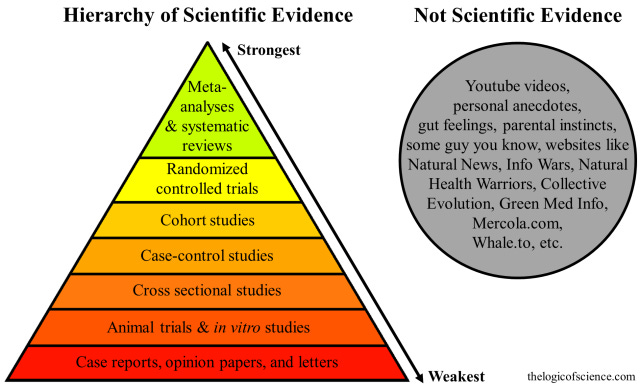
Once the methods and results are reported, an elaborate discussion is written to interpret the results given the ups and downs of the methods. They maintained that there was a “strong association between prenatal acetaminophen exposure and ADHD/ASD/other NDDs,” even after confounding. But as you can see above, there were still critical biases in play. And to make matters interesting, the main overall study analysed (Ahlqvist, 2024) found no association between Tylenol use during pregnancy and risk of autism in children, and admitted there was some level of confounding not accounted. At the end, the authors of this review concluded that “further research is needed to confirm these associations and determine causality and mechanisms.”
Despite this perspective being the most cryptic to explain, I think research and statistical literacy are two crucial skills to have in your arsenal to further understand how scientific research illustrates the complexities that non-academic media typically fail to acknowledge.
Conclusion
So was the US Government wrong?
Yes, because they treated the findings as causal not correlated.
Now, there’s a world of a difference between there might be a risk here that’s worth studying, and this definitively causes autism. When you mix nuance and mix that messaging with partisan politics, people lose trust in us, actual doctors.
By combining these two groups of perspectives together, it shows that:
Binary language can make complex things simple, but we cannot have simple answers to complex problems.
We have turned into a reactive society thirsty for oversimplification as a way of simplicity of life. That applies to the TikTokers, to the commentators, to me and you, and even to the president of the United States himself.
The problems of this world are becoming increasingly complex and critical thinking is on the decline, and I firmly believe that a new style of thinking is called for.
Thank you for reading.
Mark :)
The larger, overall problem, is that Pharam has screwed themselves completely in credibility. Just listing Purdue and Opoids hawked as 'perfectly safe.' Let's just be clear, not medicine is perfectly save otherwise we'd call it 'food' and even food isn't perfectly safe (just talk to an obese person.
As far as it causing autism, the bigger issue is that the explosion of autism isn't in level 2 and level 3 but in level 1 which was, prior to 2013, known as Aspergers and separate. When we find a huge number of men and especially those in tech are in this realm... what we used to call nerds, geeks, and techies, are now Autistic. We've pathologized personality and proclivity.
Let's not even add in all the tiktok autistics profiting off of 'neurodivergency' and 'nuerospicy' (gag) to grow likes and engagement. The layers of Autism go much much further than just Tylonol.